
Apply temporal discount to land-use layers based on an age variable
Source:R/insights_discount.R
insights_discount.RdThis function applies a temporal discount to land-use or habitat layers based on a corresponding age or maturity variable. The age variable is always connected to the layer being discounted (e.g. forest age linked to forest fraction) and represents increasing habitat value over time.
Newly established habitat (low age) does not provide full habitat value. Three maturity parameterizations are supported:
Target-age parameterization (default): use this when the available
information is the age at which a land-use class should reach a chosen
fraction of its full habitat value. The target_age parameter is the
age at which habitat reaches target of its full value:
$$H_{\mathrm{eff}} = H \times [1 - (1 - p)^{a / a_p}]$$
where \(H\) is the land-use value, \(a\) is the cell age,
\(a_p\) is target_age, and \(p\) is target. Internally,
this is equivalent to deriving the per-age discount rate:
$$d = 1 - (1 - p)^{1 / a_p}$$
and applying:
$$H_{\mathrm{eff}} = H \times [1 - (1 - d)^a]$$
This requires a land-use layer and an age or maturity layer for the same
land-use class, with age and target_age in the same time unit.
Timescale parameterization: use this when the input age represents
habitat age or time since transition into suitable land use, and a species-
or group-specific establishment/maturation timescale is available as
tau:
$$Q = 1 - \exp(-a / \tau)$$
$$H_{\mathrm{eff}} = H \times Q$$
This requires a habitat or suitable land-use layer, a matching
habitat_age layer supplied as age, and tau in the same
time unit as age. When tau is supplied, target_age and
target are ignored. The target-age and timescale parameterizations
describe the same curve family, with
\(\tau = -a_p / \log(1 - p)\).
Smoothed-threshold parameterization: use this when establishment
quality should transition smoothly around a threshold age. Supply a50,
the habitat age at which establishment quality reaches 0.5, and
k, the slope or steepness of the transition:
$$Q_{i,t} = \frac{1}{1 + \exp[-k_s(a_{i,t} - a_{50,s})]}$$
$$H_{\mathrm{eff}} = H \times Q$$
This requires a habitat or suitable land-use layer, a matching habitat-age
or time-since-transition layer supplied as age, a50 in the
same time unit as age, and k in the inverse of that time unit.
When a50 and k are supplied, target_age and
target are ignored. The tau and smoothed-threshold
parameterizations are mutually exclusive.
In the target-age and timescale forms, at
age = 0: the factor is0– no habitat value for brand-new land-use.In the target-age form, at
age = target_age: the factor istarget, e.g.0.95by default.In the timescale form, at
age = tau: the factor is1 - exp(-1), about0.63.In the smoothed-threshold form, at
age = a50: the factor is0.5;kcontrols how abruptly values move from low to high.As
ageincreases: the factor approaches1– mature habitat reaches full value.
Usage
insights_discount(
  lu,
  age,
  target_age = 20,
  target = 0.95,
  tau = NULL,
  a50 = NULL,
  k = NULL
)

# S4 method for class 'SpatRaster,SpatRaster'
insights_discount(lu,age,target_age,target,tau,a50,k)

# S4 method for class 'SpatRaster,stars'
insights_discount(lu,age,target_age,target,tau,a50,k)

# S4 method for class 'stars,SpatRaster'
insights_discount(lu,age,target_age,target,tau,a50,k)

# S4 method for class 'stars,stars'
insights_discount(lu,age,target_age,target,tau,a50,k)
Arguments
- lu
A
SpatRasteror temporalstarsobject of the land-use variable (e.g. forest fraction or area). Can be single or multi-layer.- age
A
SpatRasteror temporalstarsobject of the corresponding age or maturity variable (values>= 0). Must matchluin number of layers / time steps.- target_age
A single positive
numericage at which habitat reachestargetof full value. Used only whentau = NULLanda50 = NULL. Default:20.- target
A single
numerictarget maturity value strictly between0and1. Used only whentau = NULLanda50 = NULL. Default:0.95.- tau
Optional single positive
numericestablishment/maturation timescale. If supplied, the maturity factor is calculated as1 - exp(-age / tau)andtarget_age/targetare ignored.- a50
Optional single non-negative
numericthreshold age at which establishment quality reaches0.5. Must be supplied together withk. Mutually exclusive withtau.- k
Optional single positive
numericslope or steepness parameter for the smoothed-threshold parameterization. Must be supplied together witha50.
Examples
require(terra)
# Load package example rasters
range <- terra::rast(system.file(
"extdata/example_range.tif", package = "ibis.insights", mustWork = TRUE
))
lu <- terra::rast(system.file(
"extdata/Grassland.tif", package = "ibis.insights", mustWork = TRUE
))
lu <- lu / 10000
# Use sparse vegetation as a simple proxy for habitat age/maturity.
# In real applications, use an age or maturity layer for the same land-use class.
age <- terra::rast(system.file(
"extdata/Grassland.tif", package = "ibis.insights", mustWork = TRUE
))
age <- age / 10000
age <- age * 20
# Specify that habitat reaches 95% of full value at age 20.
lu_discounted <- insights_discount(lu, age, target_age = 20, target = 0.95)
#>
|
| | 0%
|
|======================================================================| 100%
# Alternative timescale form if tau is known directly:
lu_discounted_tau <- insights_discount(lu, age, tau = 20)
#>
|
| | 0%
|
|======================================================================| 100%
# Smoothed-threshold form:
lu_discounted_smooth <- insights_discount(lu, age, a50 = 10, k = 0.4)
#>
|
| | 0%
|
|======================================================================| 100%
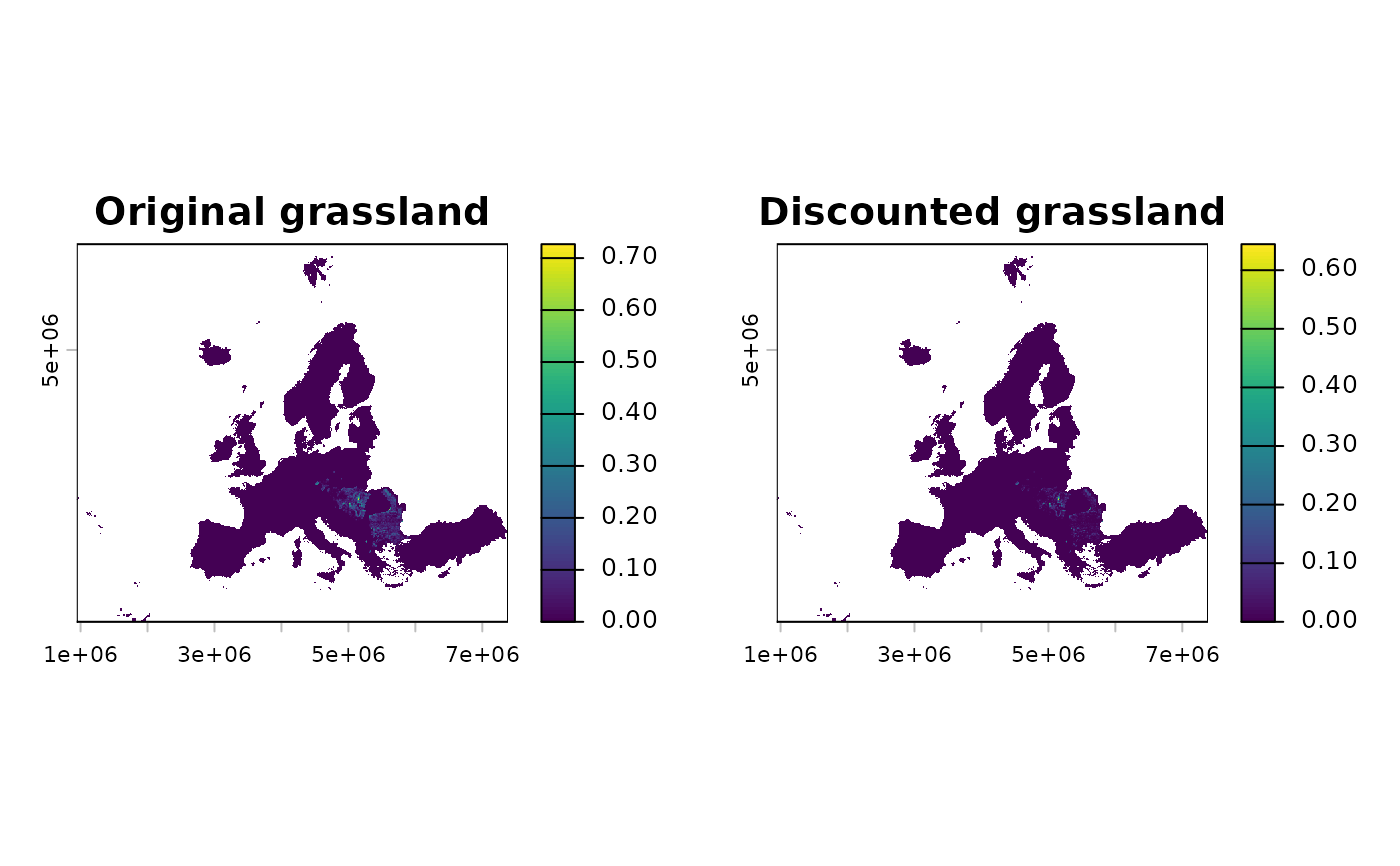
out1 <- insights_fraction(range = range, lu = lu)
out2 <- insights_fraction(range = range, lu = lu_discounted)
op <- graphics::par(mfrow = c(1, 2))
terra::plot(out1, main = "Original grassland")
terra::plot(out2, main = "Discounted grassland")
 graphics::par(op)